Nura Hossainzadeh, Ph.D.
Data researcher with a diverse background in data science, political philosophy, and the humanities.
About Me
View My Resume
View My LinkedIn Profile
Using Transformer and Large Language Models to Detect Racial Microaggressions in Text
By Neeharika Kotte, Carlos Schrupp, and Nura Hossainzadeh
Project description: Microaggressions are subtle forms of hate speech. Because they are not directly or explicitly offensive in nature, they require a nuanced approach to identify accurately, particularly in text. Our study presents both transformer and LLM (GPT-5.1) models that are able to detect microaggressive speech with a high degree of accuracy.
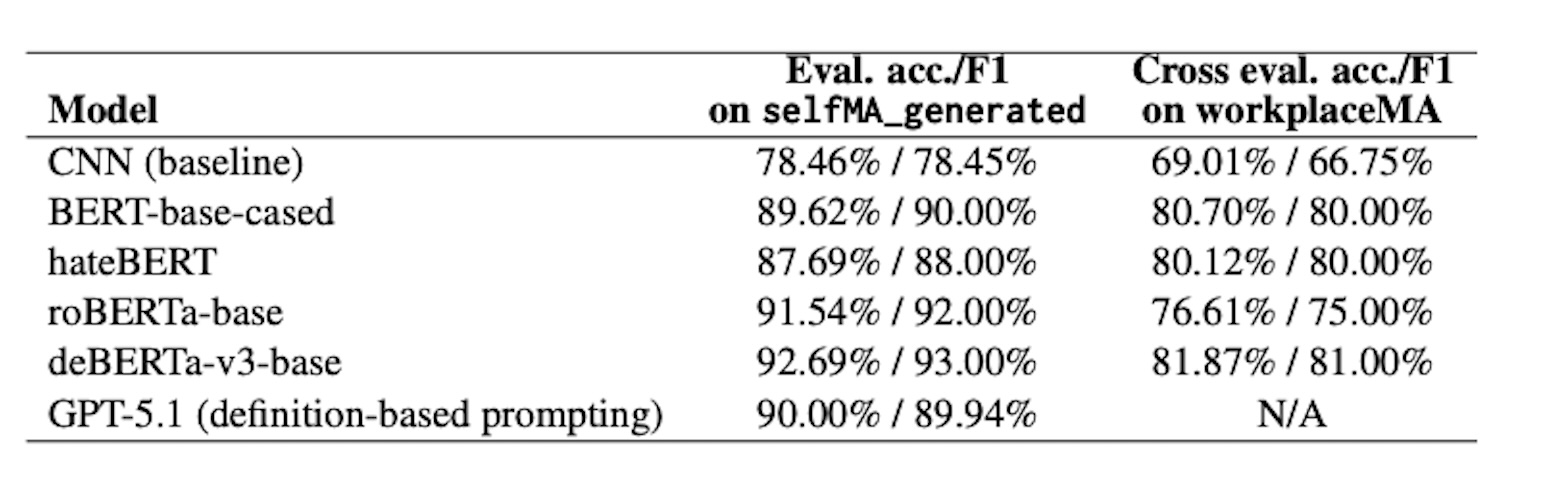
The key to achieving this result was the development of a novel dataset, used to train our transformer models and evaluate our LLM model, consisting of microaggressive statements from a well-known corpus paired with LLM-generated non-microaggressive counterparts that matched their linguistic and stylistic properties while differing in semantic meaning. We found that our LLM model achieved a 90% accuracy on a 100-entry sample of our generated dataset. Of the transformer models we tested, deBERTa exhibited the best performance, achieving high accuracy (81.87%) even when cross-evaluated on a previously unseen workplace microaggressions dataset on which it had not been trained.
Comparing Accuracy and F1 Scores of Various Transformer BERT Models, LLM Model, and Baseline CNN Model :
As indicated in the table below, our BERT models (along with the baseline CNN model) were trained on our generated novel dataset and then cross-evaluated on a workplace microaggressions dataset.
For the full paper, see: Detecting Microaggressions Using LLM-Generated Counterfactuals.
For the code we wrote to fine-tune and evaluate multiple transformer models, including our best-performing DeBERTa model, see: Code for Transformer Models.