Nura Hossainzadeh, Ph.D.

Data researcher with a diverse background in data science, political philosophy, and the humanities.
About Me
View My Resume
View My LinkedIn Profile
Partisan Differences in Perceived Voting Difficulty in the 2022 US Midterm Elections
By Richard Lumpi, Ross Vrbanac, Ayushi Goel, and Nura Hossainzadeh
Project description: In this project, we studied whether party affiliation was associated with a voter’s perceived difficulty of casting a vote in the 2022 midterm elections. The subjects of our study were voters who identified as either Democrat or Republican (or indicated they felt “closer to” either party) and their assessment of how “difficult” they felt it was to cast a vote.
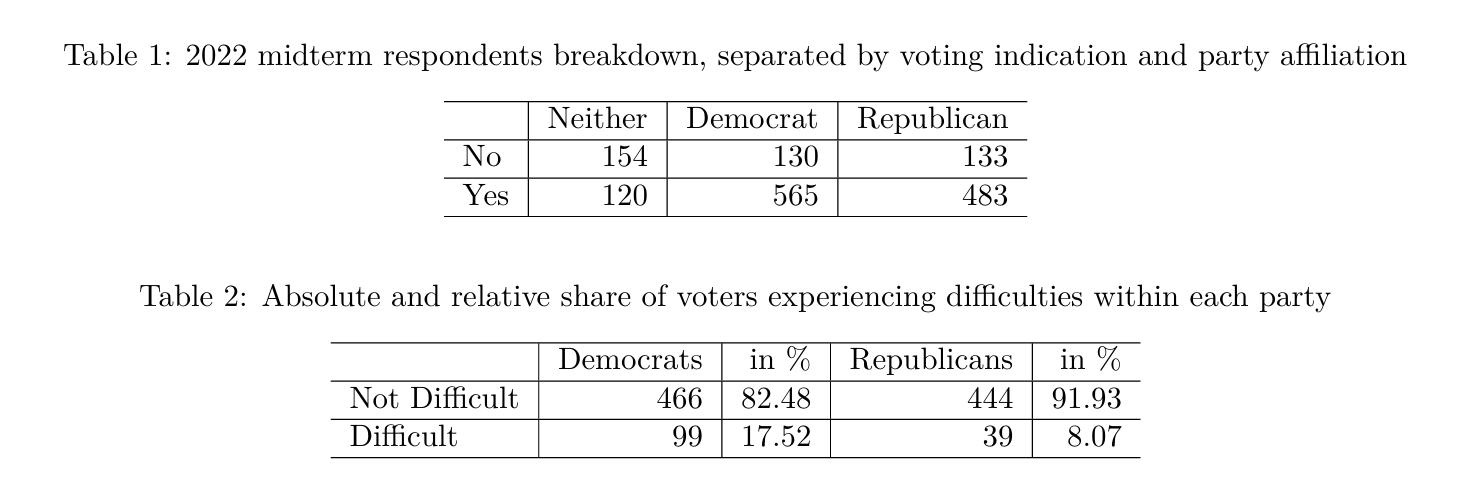
Using a two-sample t-test (using R) to measure whether there was a discrepancy between responses given by people who affiliated themselves with either party, we found that Democrats were much more likely to experience difficulty voting. Specifically, 17.52% of Democratic voters reported experiencing difficulty, whereas only 8.07% of Republican voters did. This statistically significant difference, (with a p-value < 0.01) suggests that the disparity in perceived voting difficulty discerned in this study is unlikely due to random chance.
However, while the data show a clear correlation between party affiliation and perceived voting difficulty, they do not establish causation. It is not clear that there is anything instrinsic to being a Democrat that causes a person to perceive voting to be difficult. Further research is needed to explore whether there are underlying causes of this disparity that may disproportionately affect Democratic voters.
Democrats were substantially more likely to feel like it was difficult to cast a vote.
For the full proect report, see Partisan Differences in Perceived Voting Difficulty in the 20222 US Midterm Elections.
For the source code, see this GitHub repository: Partisan Differences in Perceived Voting Difficulty in the 20222 US Midterm Elections Source Code.