Nura Hossainzadeh, Ph.D.
Data researcher with a diverse background in data science, political philosophy, and the humanities.
About Me
View My Resume
View My LinkedIn Profile
Do People from Big Families Love Big Families?
By Richard Lumpi, Ross Vrbanac, Ayushi Goel, and Nura Hossainzadeh
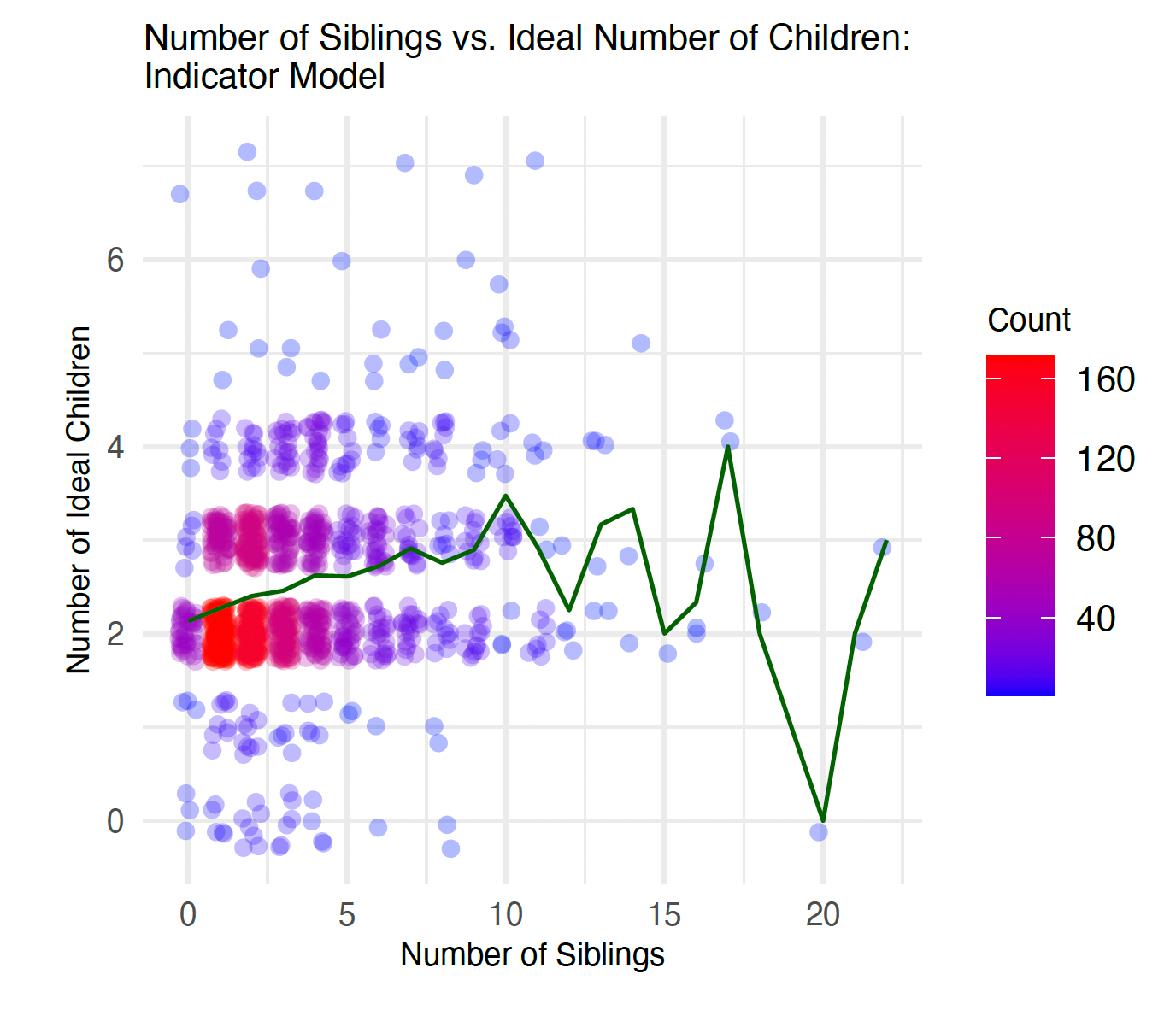
Project description: Do individuals who come from big families have positive or negative perceptions of big families? In this study, we seek to answer this question by probing whether there is a relationship between the number of siblings an individual has and what that individual says is the “ideal” number of children in a family.
Using ordinary least squares regression models to depict the relationship between these two factors, we found that there was a statistically significant relationship between a respondent’s family size and ideal family size, with the ideal growing larger as the number of siblings grew larger. (This relationship was best represented by an “indicator” model that measured the impact of each potential number of siblings in turn.)
However, this result was not practically significant since the change in ideal number of children grew in tiny fractions–the change was so small that it likely does not manifest in the real world, since it’s impossible to give birth to fractions of kids. In sum, this study did not find a meaningful relationship between the number of siblings an individual has and their ideal family size.
We explored several models, and the one that best fit the data indicated no significant correlation between number of siblings and ideal family size.
For the full project report, see: Do People from Big Families Love Big Families?.
For the source code, see this GitHub repository: Do People from Big Families Love Big Families Source Code.